
Pool Hashrate, Pool Luck and the Two Numbers Behind Your Credit
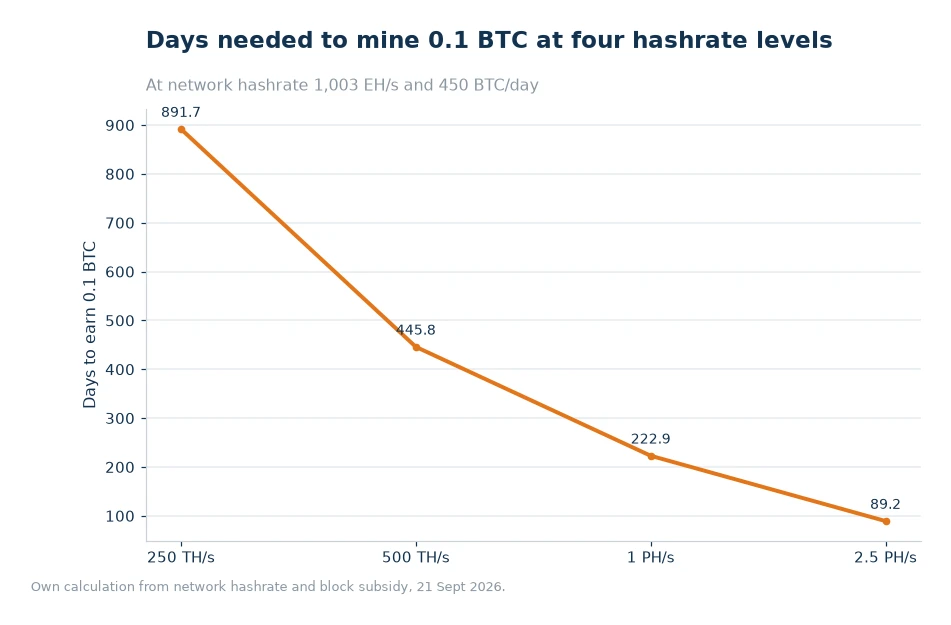
Two figures on a pool dashboard explain most of what a miner sees and controls neither of them. Pool hashrate is the combined speed of everyone mining there; Pool Luck compares the blocks actually found with the number expected. At 250 TH/s a miner earns 0.00011215 BTC a day, and reaching 0.1 BTC takes 891.7 days at that pace.

Key takeaways
- Pool hashrate is the sum of every connected miner; it sets your slice of the pool's rewards, not the size of the rewards.
- Pool Luck is found blocks divided by expected blocks over a window, so it swings widely at short intervals.
- 250 TH/s credits 0.00011215 BTC a day, and 0.1 BTC takes 891.7 days at that rate.
- At 2.5 PH/s the same 0.1 BTC target takes 89.2 days, ten times faster for ten times the hashrate.
What pool hashrate is, and what it is not
A pool's hashrate is the sum of the machines pointed at it. It is not the network hashrate, which stood at about 1,003 EH/s in the 21 September 2026 reading and includes every miner on every pool plus those mining solo. The two numbers answer different questions. Network hashrate sets how much coin one unit of hashing earns. Pool hashrate sets how that coin is divided among the people who contributed the work.
The distinction matters because miners routinely compare pools by size and expect the larger one to pay more. It does not, at least not in expected value. If a pool holds twice the hashrate, it finds roughly twice the blocks and each miner's slice is half as large, so the product is unchanged. What changes is the variance: a large pool finds blocks more regularly, so the gap between expected and actual income over a week is smaller.
The ViaBTC Pool Hashrate page publishes the live figure for the pool, which is the denominator in every share calculation on the account. Watch it across a month and you will see it move by a few percent as miners join and leave; watch it across a difficulty cycle and the movement is larger.
Pool Luck is a ratio, not a mood
Pool Luck takes the blocks a pool actually found in a window and divides by the number it should have found given its hashrate and the network difficulty. A reading of 100% means the pool hit its expected count exactly. Above 100% means it found more blocks than expected; below 100% means fewer. Over a year the figure tends toward 100%, because the underlying process is random and large samples converge.
The mistake is reading a short window as a trend. Over an hour, a pool can find twice as many blocks as expected or none at all, and neither outcome says anything about the pool's quality. Over a day the swings are smaller, over a month smaller still. Miners who check Pool Luck every few hours are watching noise and calling it performance.
There is a second layer to the term. Luck belongs to the pool's block discovery, but whether it reaches a miner's balance depends on the payout scheme. Under PPS+ the block-reward component is settled per share against current difficulty, so the pool's luck stays with the pool. Under PPLNS the miner's credit depends on which blocks were found during the five-round window, so a lucky stretch shows up directly. The fee schedule lists the rate attached to each component, which is the other half of judging what a scheme costs.
The same target at four hashrates
The table fixes the goal at 0.1 BTC and varies the hashrate. Every column is arithmetic on the same network reading, so the only thing that changes is the pace.
| Hashrate | BTC per day | Days to 0.1 BTC | Weeks at that pace |
|---|---|---|---|
| 250 TH/s | 0.00011215 | 891.7 | 127.4 |
| 500 TH/s | 0.00022430 | 445.8 | 63.7 |
| 1 PH/s | 0.00044861 | 222.9 | 31.8 |
| 2.5 PH/s | 0.00112152 | 89.2 | 12.7 |
The weeks column is the same information in a unit that suits planning. At 250 TH/s, 127 weeks is long enough that a difficulty change will intervene several times, which is why the table is a snapshot rather than a schedule. Use it to compare options on the same day, not to promise a date.
Worked example
- Daily emission: 144 × 3.125 = 450 BTC.
- A terahash's slice: 450 ÷ 1,003,000,000 = 0.0000004486 BTC daily.
- 250 TH/s: 250 × 0.0000004486 = 0.00011215 BTC.
- Days to 0.1 BTC: 0.1 ÷ 0.00011215 = 891.7 days.
- In dollars: 0.00011215 × 84,692 = $9.50 a day, and 0.1 BTC is $8,469.20.
- 500 TH/s doubles the daily rate to 0.00022430 BTC and halves the wait to 445.8 days.
- 1 PH/s is 1,000 TH/s: 0.00044861 BTC a day, 222.9 days to the target.
- 2.5 PH/s is 2,500 TH/s: 0.00112152 BTC a day, and 0.1 ÷ 0.00112152 = 89.2 days.
Why pool size changes the ride, not the destination
Consider two pools with equal fees, one holding a tenth of the network and one holding a hundredth. Your expected daily income is identical in both, because the smaller pool finds a tenth as many blocks and gives you a ten times larger slice of each. The difference is the distribution around that expectation. The small pool will have weeks well above and well below the average; the large pool's weeks cluster closer to it.
For a PPS+ miner, the distribution barely matters, because settlement is per share rather than per block. For a PPLNS miner it matters a great deal. That is why the same hardware can feel steady on one pool and erratic on another without either pool being dishonest. The scheme and the pool's size together decide how much of the network's randomness reaches your balance.
Pool hashrate also carries a concentration question that has nothing to do with your income. A pool with a very large share of the network is a bigger single point of failure for the chain, and miners sometimes spread hashrate for that reason alone. That is a judgement about the network rather than about returns, and it is worth making deliberately rather than by default.
Reading the luck figure without overreacting
Check the window before you check the number. A luck figure labeled as a daily reading and one labeled as a monthly reading are not comparable, and neither is a figure that silently resets. If the page does not state the window, treat the number as decoration and use the credit history instead, which is the only luck measure that ends up in your balance.
The credit history has its own lesson. Plot your daily credits for a month and you will see a spread that no calculator predicts. Under PPS+ the spread should be narrow and mostly explained by uptime. Under PPLNS it will be wider and partly explained by block timing. Knowing which pattern you are looking at prevents a lot of unnecessary support tickets.
Frequently asked questions
Does a bigger pool pay more per terahash?
Not in expectation. A larger pool finds more blocks and divides them among more miners, so the product is roughly the same. The practical difference is smoother income and, sometimes, a different fee structure.
What does a Pool Luck reading above 100% mean?
That the pool found more blocks than its hashrate and the difficulty implied for that window. It is a description of the past, not a forecast, and short windows regularly swing far above and below 100%.
Do PPS+ miners care about Pool Luck?
Barely. The block-reward component settles hourly against current difficulty, so the pool's block-finding luck does not change the credit. Miners on PPLNS feel it directly because payment depends on the blocks found in the window.
Watch the denominator, plan with the numerator
Pool hashrate tells you how crowded the room is; your own hashrate and the network total decide how much coin the room produces. Keep an eye on the first, plan with the second. The Statistics page carries the network figures that make the arithmetic work, and the pool page shows the live denominator beside them.
Sources: ViaBTC's pool state and statistics pages, for pool and network hashrate, plus its pricing page for the listed 4% and 2% rates[1]. The 0.1 BTC timings rest on data read 21 Sept 2026: 1,003 EH/s, 132.76 T, 450 BTC a day from 3.125 × 144, BTC $84,692. Continuous uptime is assumed. Published 22 Oct 2026.