
Car and Air-Care Scent Range: A Scope Checklist Before You Order
A car or air-care order goes wrong in the gaps between workstreams, not inside any one of them. The scent is agreed, the housing is chosen, the carton is designed, and then somebody discovers that the decoration minimum is higher than the filling minimum, or that the retail pack needs a warning panel nobody scheduled. A scope checklist is not bureaucracy; it is the shortest document that prevents those discoveries. Written once, approved by both sides, it turns a range of products into a set of decisions with owners.
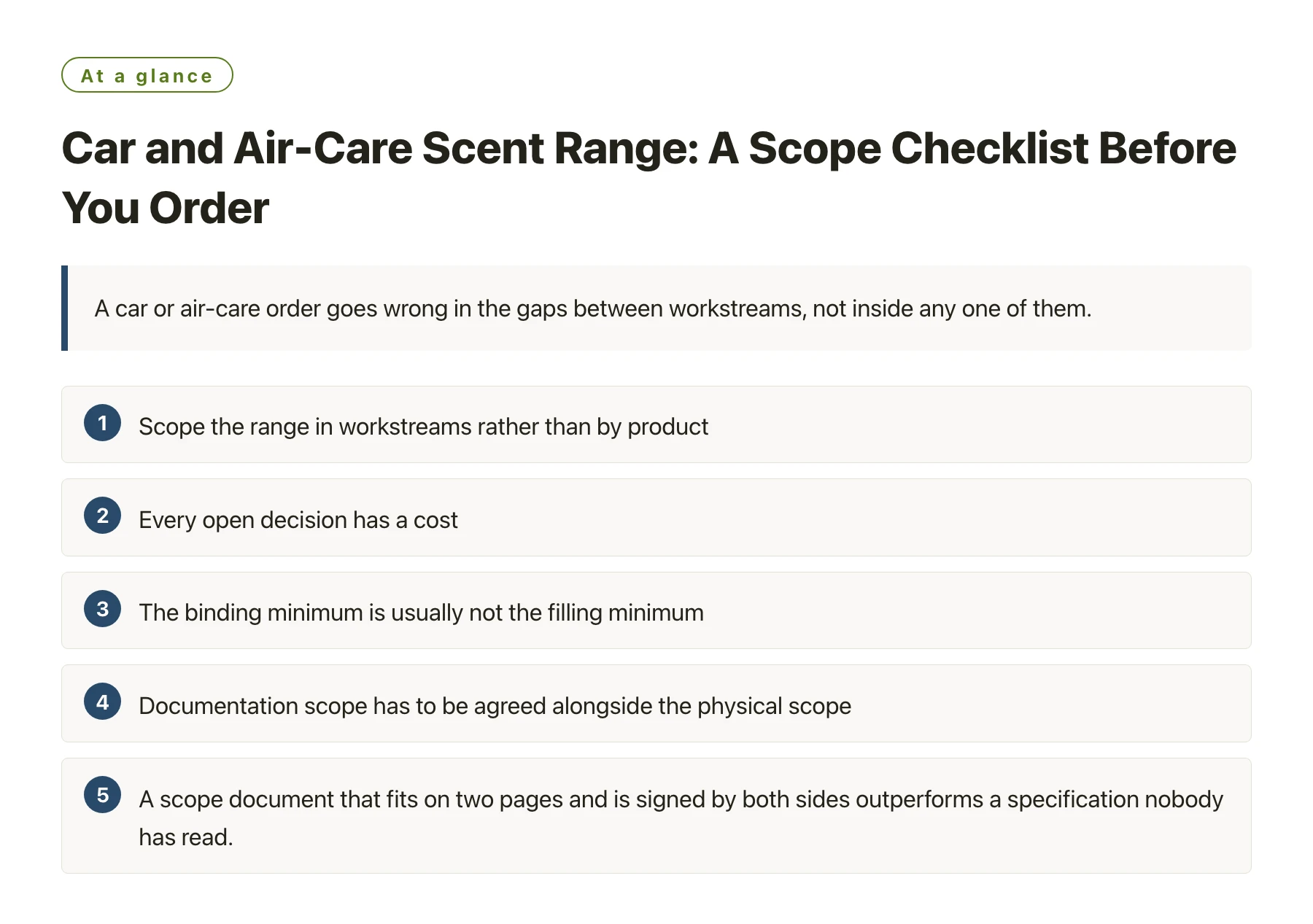
Key takeawaysScope the range in workstreams rather than by product, because scent, housing, finishing, filling, packaging and documentation each carry their own minimum and lead time. · Every open decision has a cost, and the cost rises sharply once the order is confirmed, so name an owner and a date for each one. · The binding minimum is usually not the filling minimum, so identify which workstream sets the order quantity before you negotiate price. · Documentation scope has to be agreed alongside the physical scope, because the category and market list determine what the supplier can declare. · A scope document that fits on two pages and is signed by both sides outperforms a specification nobody has read.
Operations teams inherit fragrance projects at the point where the creative decisions look finished and the physical ones are still open. The scent has been chosen, the brand has approved a look, and the order date is approaching. What remains is a set of interdependent decisions about quantities, minimums and specifications, and each of them can move the others.
This checklist is written for the person coordinating the order rather than for the perfumer or the designer, and it keeps the constraints of a niche fragrance house in view. It is deliberately short, and its purpose is to expose the decisions that tend to be left open until they become expensive.
Scope by workstream, not by product
A range of four air-care products is not four projects, it is six workstreams applied across four items. Scent development, housing sourcing, decoration, filling, packaging and documentation each have their own minimum, lead time and approval path. Listing the range by product hides those constraints behind a tidy table; listing it by workstream reveals where the range will actually get stuck.
The practical consequence is that the order quantity is set by whichever workstream is most constrained. A custom carton, a printed label or a decorative collar will frequently demand a larger quantity than filling does, and negotiations that focus on the filling minimum miss the number that matters.
It is also worth deciding early whether the range shares components. A single housing across three scents, in three colours, is a different commercial proposition from three bespoke housings, and the difference is measurable before any design work begins.
Where the range is being developed rather than sourced from a catalogue, the scope conversation should include who carries each workstream. A partner that covers development, components and filling internally removes several interfaces; fragrance OEM/ODM production partner describes the shape of that arrangement, and the checklist below still applies, because scope that is not written down is scope that can move.
The scope checklist, and the cost of leaving each line open
| Scope area | What has to be decided | Cost of leaving it open |
|---|---|---|
| Scent and concentration | Number of scents in the range, target intensity, and the format each one is designed for. | Late reformulation, an extra sample round, or a scent that underperforms in the chosen housing. |
| Housing and mechanism | Standard component or custom tooling, and who owns the tool afterwards. | Tooling cost discovered after artwork approval, and a lead time that cannot be recovered. |
| Decoration | Finish, number of passes, tolerance and the decoration minimum. | A quantity set below the decoration minimum, or a finish change after the master standard is agreed. |
| Filling and assembly | Fill weight, conditioning time, sealing method and packing configuration. | Rework at the filling station, or a packing configuration that does not fit the retail carton. |
| Primary and retail packaging | Carton structure, inserts, warnings and any recycled or recyclability claim. | Artwork revision after printing, or a claim that the construction cannot support. |
| Documentation | Category classification, market list, declarations, transport classification and batch records. | A shipment held at the port, or a label that has to be reprinted for one market. |
| Volumes and dates | First order quantity, split by scent, and the date the goods have to arrive rather than ship. | Air freight, split shipments, or a launch that moves because one component arrived late. |
| Approval gates | Who approves the scent, the master standard, the artwork and the pre-production sample. | Feedback arriving late, and a second round nobody budgeted for. |
Two pages, eight lines, one owner and one date per line. The document is worth writing because it converts a set of assumptions into commitments that can be checked at the next meeting.
Where the scope document meets the specification
Scope and specification are different documents and both are needed. The scope says what will be done, by whom, in what quantity and by when. The specification says how the product must perform, with the tests and criteria attached. A project with a specification and no scope tenders well and executes badly; a project with a scope and no specification executes quickly and drifts.
The specification is also where the material restrictions live, which is why the category classification has to be agreed before the specification is frozen. The frameworks that govern fragrance use restrictions are maintained by the industry and are revised over time, so the version being applied should be named in the specification rather than assumed [1].
One further line belongs in the scope, and it concerns the trade relationship rather than the product. The segment has been a growth area for brands extending a scent from fine fragrance into the home and the vehicle, and coverage of that movement is easy to find in the sector press [2]. Growth is useful context but it is not a specification. Say which entity will produce the goods, which entity will sign the agreement, and which entity holds the documentation.
Where a supplier can show how earlier projects were scoped and delivered, the document becomes easier to trust. Xuelei case studies is one place to look for that kind of reference material, and the useful question when you look is not whether the projects are impressive but whether the same workstream structure appears in them.
Once the scope is signed, the coordinator's job changes from asking questions to tracking answers. Keep the document alive, version it, and treat any change to it as a change to the price and the date until the supplier says otherwise in writing. Asking this Guangzhou fragrance house for the same document back is a fair test of the relationship: a supplier that returns a versioned scope with owners and dates named has a working process, and one that returns a brochure does not.
Before the order confirmation goes out, read the scope document aloud to the supplier on a call and ask them to name anything they would change. Five minutes of that catches the assumptions that a written exchange leaves buried.
Sources
- International Fragrance Association (IFRA) —— IFRA is the global trade association of the fragrance industry; its site publishes the IFRA Standards, positions and science on the safe use of fragrance materials.
- Cosmetics & Toiletries —— A technical magazine for cosmetic formulators, covering ingredients, formulation science and testing methods.
Frequently asked questions
What is the difference between a scope document and a specification?
The scope states what will be done, by whom, in what quantity and by when. The specification states how the product must perform and how that will be tested. You need both, and they are approved by different people.
Which minimum usually sets the order quantity?
Usually a component or decoration minimum rather than the filling minimum. Check tooling, printing, coating and carton minimums before you negotiate the filling quantity.
Should a range share components across scents?
Sharing housings, closures and cartons usually reduces cost and simplifies the schedule, at the price of less differentiation. Decide this before design work starts rather than after.
When should documentation be scoped?
At the same time as the physical scope. The category classification and market list determine which declarations are possible, and discovering a gap after the label is printed is expensive.
How often should the scope document be revised?
Every time a decision changes, with a version number and a date. An unversioned scope document becomes a source of disagreement rather than a record of agreement.
The boats came in this morning.
Twelve partner vessels. One wood-fired hearth. A table waiting for you on the wharf.
Reserve a Table