
Stainless Steel Jewelry Manufacturing: Tarnish-Free Claims
Tarnish is a chemical reaction, not a quality grade, and knowing which metal it can happen to is the difference between an accurate product page and a complaint. Stainless steel does not form the sulphide film that dulls silver and brass, which is why a steel line can be sold on daily wear while a plated line is sold on colour. The published windows behind both are 25–35 days for sampling and 3–4 weeks for production.

Key takeaways
- Tarnish is surface chemistry: steel resists it, silver and brass need an anti-tarnish e-coating.
- Stainless steel carries a 316L hallmark and starts at 100–150 pcs by style.
- Silver and brass take multi-layer 14K / 18K / 24K gold and rhodium plating; steel takes PVD vacuum plating.
- REACH compliance covers lead, cadmium and nickel — the metals that matter on a skin-contact claim.
What tarnish actually is
Tarnish is a thin film that forms when a metal surface reacts with sulphur compounds and oxygen in the air. On silver it appears as a yellow-brown to black layer; on copper alloys such as brass it turns green or grey. The film sits on the surface, so it can be removed with a cloth and a mild polish, but it returns because the metal underneath is still reactive.
Two things change the outcome. The first is what the piece is made of: a steel alloy that carries its corrosion resistance through the metal rather than in a coating does not go through that reaction at all. The second is what sits on top: a plated or deposited layer can separate the reactive metal from the air, but only for as long as the layer stays intact. That is why the useful question about a tarnish claim is not yes or no, but which metal and which coating.
Why steel and brass behave differently in wear
Stainless steel is an alloy of iron, chromium and other elements, and it holds up in water, sweat and everyday abrasion. A 316L ring can be worn in the shower and in a pool without the surface changing colour, because there is no plating layer to break down and no base metal underneath waiting to oxidise. This is also why steel is usually the material chosen when a piece is meant to be worn and forgotten.
Brass and silver are reactive base materials. Brass is plated, so it looks like gold while the body stays an alloy, and silver takes an anti-tarnish e-coating on top of the polished surface. Both are legitimate ways to build a collection: plated brass delivers four colour options on one silhouette, and silver delivers the metal value that a higher retail price rests on. Neither is sold as tarnish-proof, and a maker that says otherwise is describing a test result rather than a property.
Which grade the piece is made from decides how much of the tarnish question is even asked. 316L adds 2–3% molybdenum to the alloy and is published as 100% waterproof — shower-safe, sweatproof, swim-proof — and medical-grade hypoallergenic, so the surface chemistry has less to work with. 304 is the daily-wear grade: water-resistant, nickel and lead safe, and finished with reliable commercial vacuum plating for programmes where cost-effectiveness and volume matter more than premium positioning.
Where the finish claims come from
The published finish list is short and specific: multi-layer precious metal electroplating in 14K gold, 18K gold, 24K gold and rhodium, with a protective anti-tarnish e-coating added on silver and brass, and PVD vacuum plating on stainless steel. Marks follow the metal — the S925 hallmark, 316L for stainless steel and 18KGP for gold-plated pieces — and all three are applied by laser engraving, in the same operation as a brand's own logo.
Claims should follow the same discipline. "Gold-plated" means a plated layer over a base metal, which is what 18KGP states plainly. "Gold" alone implies solid metal and is not supported by the process. A product page that repeats the manufacturer's own terms has nothing to walk back later.
| Base metal | Published finish | Minimum per design | Tarnish behaviour |
|---|---|---|---|
| Stainless steel | PVD vacuum plating, 316L hallmark | 100–150 pcs | No sulphide film forms on the alloy itself |
| 925 sterling silver | Multi-layer plating plus anti-tarnish e-coating | 50 pcs | Reactive; the coating is the protection |
| Artisan eco-brass | Multi-layer 14K / 18K / 24K gold and rhodium plus e-coating | 100 pcs | Reactive base metal under a plated layer |
A comparison table is only as good as its column headings. What a buyer needs from a 316L stainless steel jewelry manufacturer is the MOQ per design shown next to the finish route and the mark, because all three are settled in the same conversation. A minimum quoted without the metal, or a finish quoted without the hallmark, is an answer that will need asking again — the published figures apply per design and per material, so a mixed-metal collection is three separate commitments.
Worked example: the published windows expressed in weeks
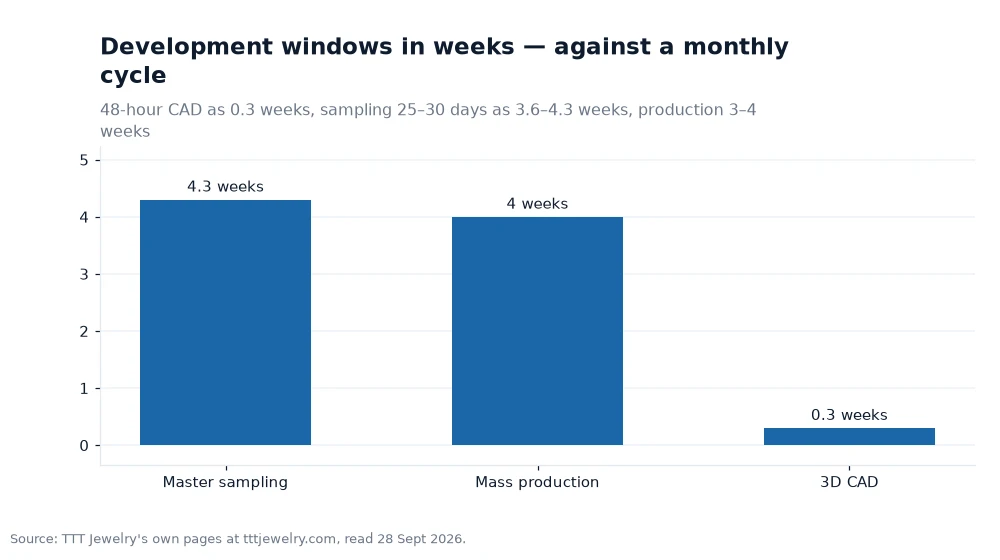
A monthly cycle is the unit most planning sheets use, so converting the published figures is worth doing by hand. Master sampling runs 25–35 days: 25 ÷ 7 = 3.6 weeks at the fast end, 30 ÷ 7 = 4.3 in the middle of the band, and 35 ÷ 7 = 5 at the slow end. Mass production is quoted directly at 3–4 weeks. The CAD stage is under 48 hours, which is 48 ÷ 24 = 2 days, and 2 ÷ 7 = 0.29 weeks — rounded to 0.3.
Read together, the three bars describe a development block somewhere between 7 and 9.3 weeks rather than a manufacturing trick: 0.3 weeks of screen work, 3.6 to 5 weeks of bench work on the sample, and up to 4 weeks of running the approved design. Only the middle bar moves when a design is unusual, which is why the sample stage is where a launch date is won or lost.
Testing a claim before it goes on a product page
Three checks cover most of the risk. First, decide which metal the claim is about, because a steel statement does not transfer to a plated brass piece. Second, ask for the restricted substance position — REACH compliance covering lead, cadmium and nickel is the published one, and nickel is the metal most likely to matter on a skin-contact item. Third, hold the sample: a physical master sample shows the surface under real light, which no photograph of a render does.
Behind all three sits the quality system. ISO 9001:2015 means the process is documented and repeatable, and a BSCI audit covers labour practices in the facility. Neither document says a ring will stay bright forever; together with the materials statement they say which claims are supportable and which are not.
Frequently asked questions
Will a plated stainless steel ring lose its colour?
Any coating is a surface layer, so heavy abrasion will eventually show through. Steel resists the corrosion side of the problem, and PVD vacuum plating is the published finish for that metal.
Does silver need special packaging to stay bright?
Protection starts at the finish rather than the box: silver and brass both receive a protective anti-tarnish e-coating, and pouches, backing cards and gift boxes are available as part of the standard packaging list.
Which metal is safest for sensitive skin?
Stainless steel is the usual answer for daily wear, and all published materials are REACH compliant on lead, cadmium and nickel — ask for the statement rather than the logo.
Working with a maker that owns its plating tank
Ask for the base metal, the finish and the mark in writing, then match them against the sample in your hand. The three should agree, and when they do, the product page writes itself. For a collection that mixes metals, the buyer FAQ page answers the process questions in one place, and the sterling silver manufacturing notes set out how the reactive metal is handled from casting to coating.
The specification this article works from — sampling over 25–35 days plus the 100–150 piece stainless minimum (by style) plus the 316L versus 304 comparison — is published on tttjewelry.com (read 28 Sept 2026). The percentages quoted above are my own rather than the manufacturer's[1].